From spec to live multiplayer game in seven days
A real-time, four-player card game with bots, accounts and cheat-proof hidden hands, taken from a design spec to a live deployment in a week.
 Euchre, Parlour Edition · Internal project
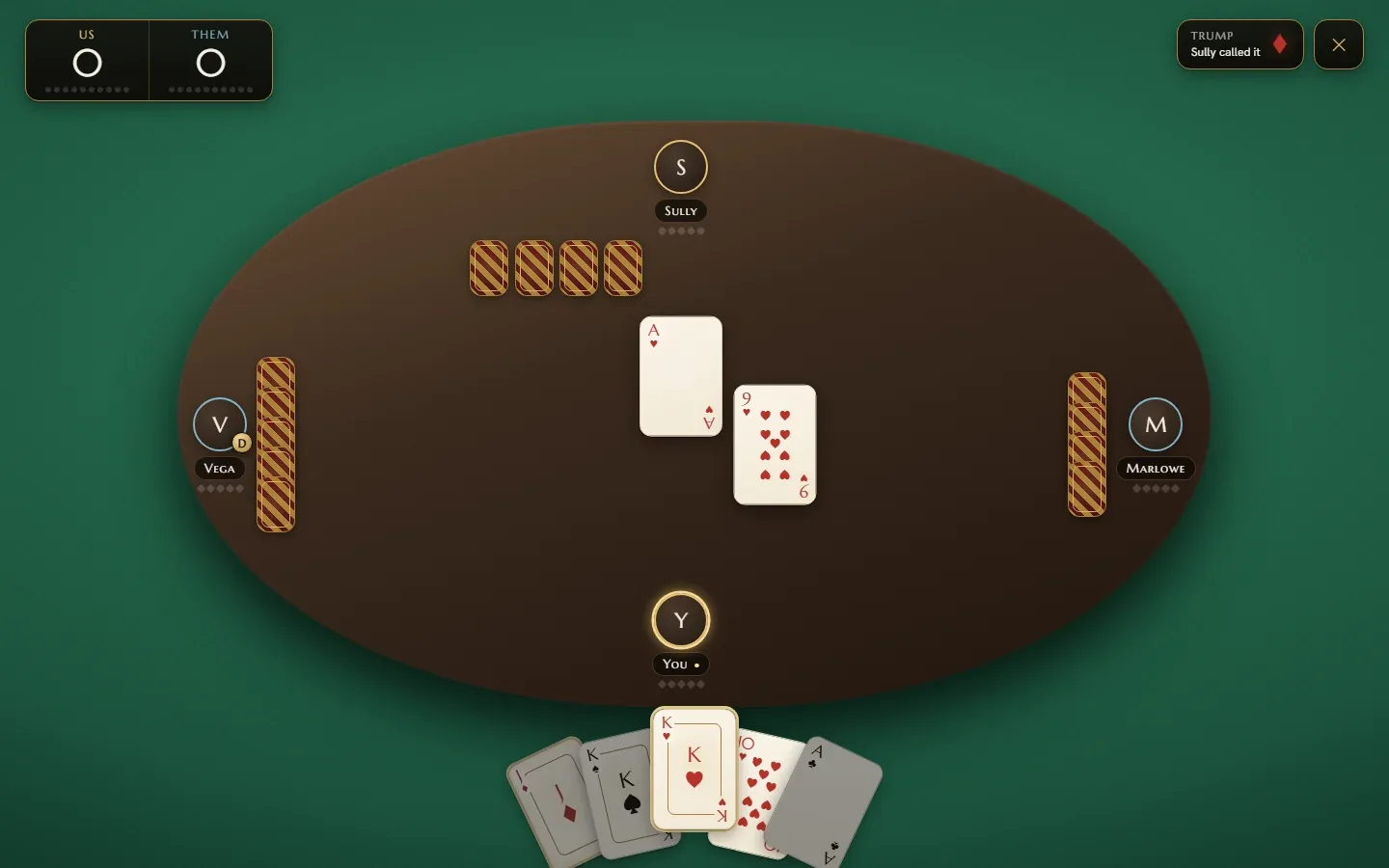
Most companies have a version of this problem: an app idea that needs real-time collaboration, accounts and rules that can't be bent, and a quote from an agency that says three months. We wanted to know how fast a disciplined, AI-assisted team could take a well-specified product from a design document to something live on the internet, without cutting the corners that matter: security, correctness and tests. We picked a deliberately demanding test case: Euchre, the four-player partnership card game, played in real time with hidden hands.
At a glance
| Client | Internal project, a delivery-speed test |
| Industry | Consumer apps and games |
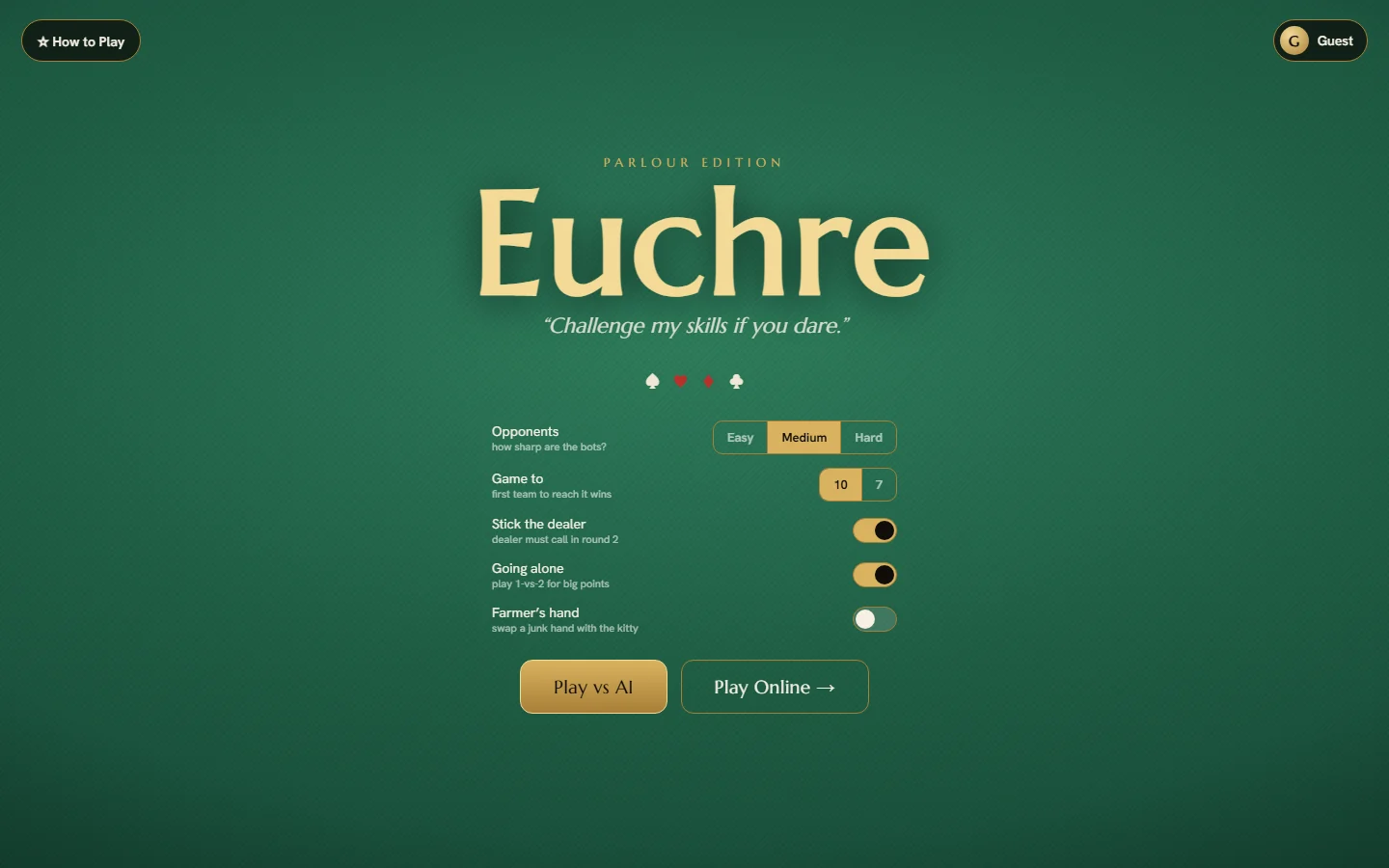
| What we built | A web card game you can play against bots offline or against real people online, with accounts, a lobby and house rules |
| Where AI fits | In the build: AI agents wrote the app from a written specification and a clickable design prototype. In the game, the opponents are hand-written strategy bots, not a language model. |
| Stack | A Next.js web app on Vercel, with Supabase for the database, sign-in and real-time sync |
| Status | A real-time multiplayer card game, live at euchre-nu.vercel.app |
The old way
- Write a requirements document, then wait for design.
- Hand off to developers, who discover the gaps in the spec.
- Build the single-player version, then rebuild large parts of it for multiplayer.
- Bolt on security late, once someone asks "can a player see the other hands?"
- Ship in months, with tests as an afterthought.
What we built
The project started with a full design specification (architecture, rules, data model, security and testing) and a clickable prototype. From there, the app was built in phases: a local game against bots, then accounts, then online multiplayer, then polish.
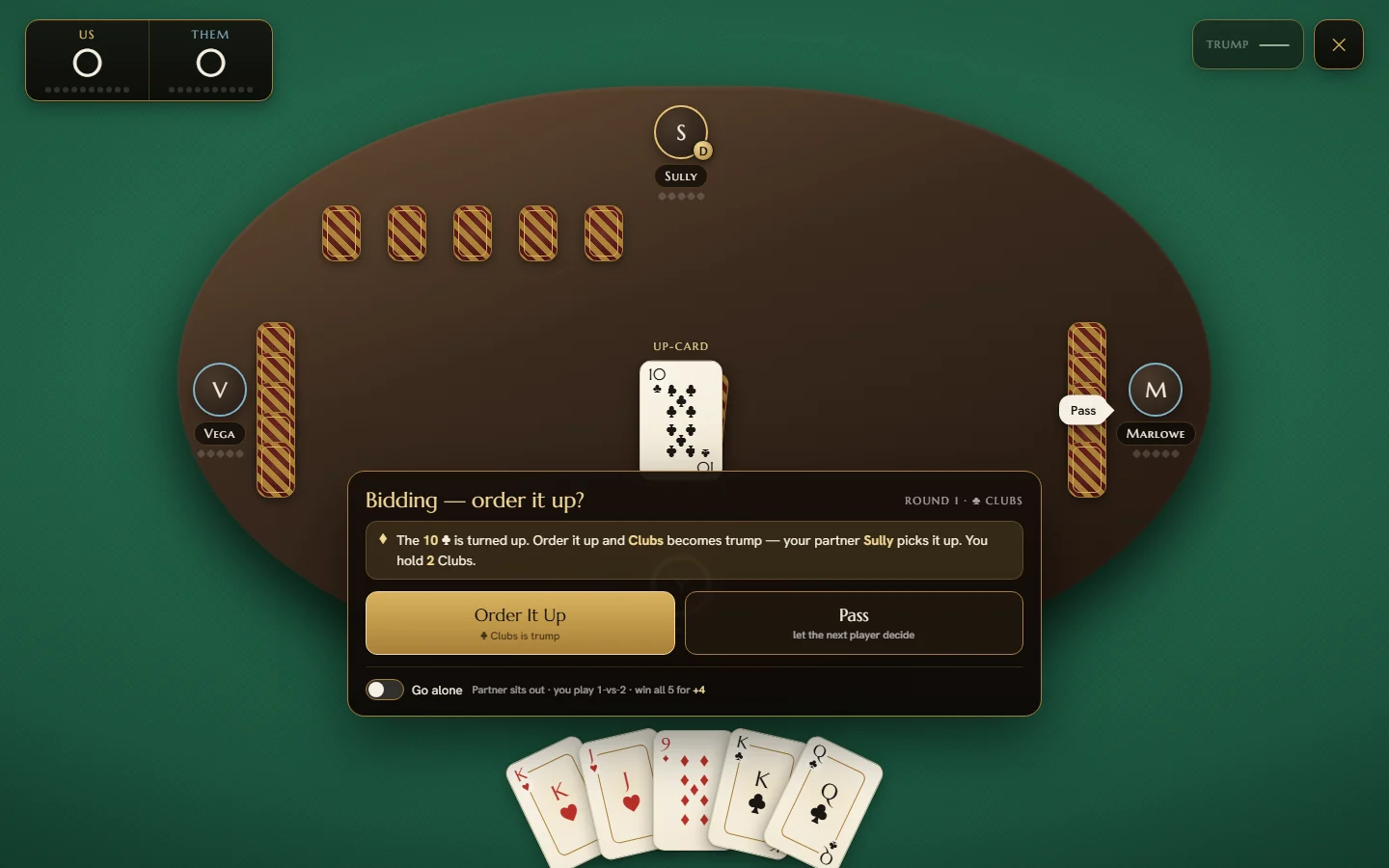
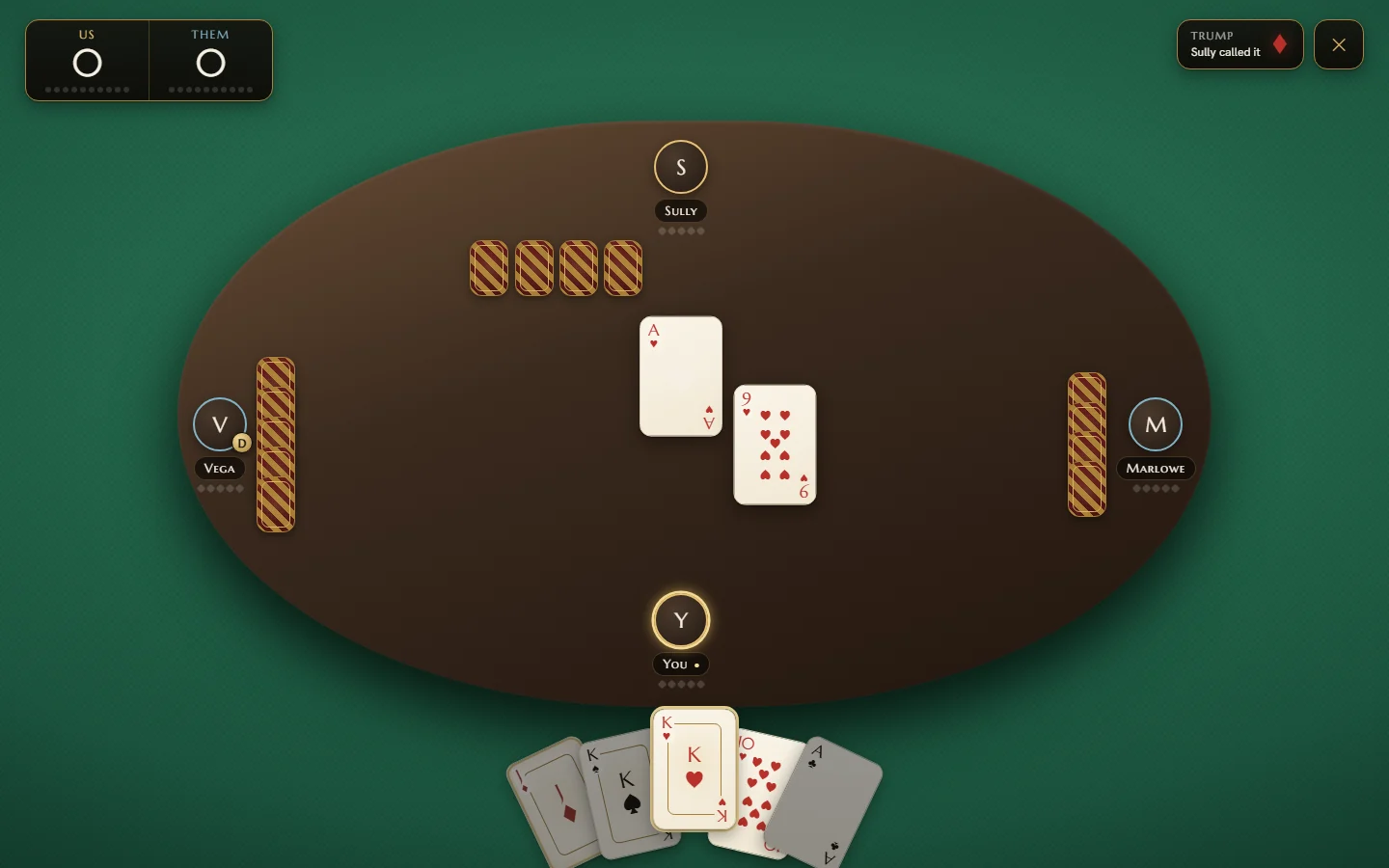
The key decision was one game engine used two ways. The same rules code runs in the browser for offline play against bots, and on the server for online games, where the server is the referee and clients are never trusted. Bots fill empty seats online, and a turn timer covers players who walk away.
Players can sign in as a guest, with email and password, or with a magic link. They choose bot difficulty, play to 10 or 7, and switch house rules (stick the dealer, going alone, Farmer's Hand) on the home screen or in the lobby. Stats are tracked per player.
How the workflow changes
| Step | Before | After |
|---|---|---|
| From idea to build | Requirements, then design, then development, in sequence | A written spec and a clickable prototype handed straight to an AI-assisted build |
| Single to multiplayer | Rebuild for online play | One engine runs in the browser and on the server, so multiplayer reuses the same rules |
| Security | Added late | Designed in: the database itself only lets each player read their own hand |
| Testing | After the fact | Engine, bot and component tests written alongside the code |
| Shipping | Months | Live on day seven |
Inside the build
Under the hood
- Server-authoritative play. In online games every move is checked and applied by the server using the shared engine. A modified client can't play an illegal card or skip a turn.
- Hidden cards stay hidden, at the database level. Each player can read only their own hand; the shuffle and the kitty live in a server-only table, and every view sent to a client is redacted for that seat. An automated test checks that secrets never reach the wrong player.
- A fair "hard" bot. The strongest bot counts cards from what has been played, without peeking at hidden hands. A property test plays many full games to confirm every bot move, at every difficulty, is legal.
- Deterministic engine. Shuffles are seeded, so a full game can be replayed exactly in tests, from the deal to the winning point.
By the numbers
- 7 days from the first commit (June 4, 2026) to the first production deployment (June 10).
- 17 commits.
- 67 automated tests across 8 files, including database tests that check hidden hands never reach the wrong seat.
- Live at euchre-nu.vercel.app.
Example scenario
Example scenario (illustrative): A board-game café wants a branded online version of its house tournament game for members to play between events. It has the rules written down and a few sketches of the table. Working from a one-week spec-to-launch plan, the café gets a playable bot mode in the first days, accounts and online tables after that, and a live link to share at the next event, with the server enforcing the café's house rules.
What this means for your business
The reusable capability is fast, safe delivery of real-time apps: a written spec, an AI-assisted build, and security designed into the data layer from the first day. It fits:
- Startups that need a working real-time product to test with users, fast
- Businesses adding live collaboration, bookings or shared dashboards to an existing service
- Membership organizations and communities wanting their own interactive app
- Any product where users must never see each other's data
Second Voyage builds AI systems that are held to a standard you can check. Talk to us about yours.