An AI deal coach that fact-checks itself before a salesperson ever sees it
DealHatch reads a deal's emails, meetings and documents and drafts negotiation strategies, talk tracks and forecasts, then strips out any claim it can't back with evidence.
 DealHatch · Internal product, built with co-founder Nick Gotsy
A sales rep heading into a renewal call has the facts scattered across a CRM, an inbox, a calendar and a shared drive. The tools that promise to help mostly generate confident text. In a negotiation, a confident invented fact, such as a discount that was never offered, a stakeholder who never said it, or a deadline that doesn't exist, is worse than no help at all.
At a glance
| Client | Our own product, built with co-founder Nick Gotsy |
| Industry | B2B sales: account executives, sales managers and revenue leaders |
| What we built | A negotiation co-pilot that turns a deal's history into ranked strategies, a play-by-play for the next meeting, talk tracks, qualification and forecasts |
| Where AI fits | A multi-step Google Gemini pipeline with retrieval over the deal's own documents, then a fact-check that repairs or removes anything unsupported |
| Stack | Next.js, NestJS, PostgreSQL with vector search, and background job queues |
| Status | A negotiation co-pilot for B2B sales teams |
The old way
- Before a key call, the rep rereads weeks of email threads and meeting notes.
- They reconstruct who said what, which concessions are on the table and what the buyer cares about.
- Strategy comes from memory, a manager's advice or a generic sales framework.
- Forecasts are a rep's gut feeling typed into a CRM field.
- If they use a general-purpose AI chatbot, they paste in fragments and hope its answer doesn't invent details.
What we built
DealHatch keeps every deal in one workspace and does the reading for you.
- It assembles the context. Emails, calendar events, meeting notes and uploaded documents are matched to the right deal, with suggested matches waiting for the rep's approval.
- A pipeline of specialist steps, not one big prompt. Separate stages work out the deal's context, its interaction history and the possible angles, then draft a strategy skeleton and fill in the detail, a playbook, a play-by-play and qualification.
- It fact-checks its own output. Every strategy, playbook, play-by-play and chat answer is checked against the deal's sources for unsupported money figures, percentages, dates, names and attributed quotes. The system tries one repair. Anything still unsupported is removed rather than shown. Only sendable text such as a draft email keeps a clearly marked
[placeholder]for the rep to fill in. - Tone is the rep's call. Strategies can be tuned from formal to collaborative and from subtle to strong, per deal.
How the workflow changes
| Step | Before | With DealHatch |
|---|---|---|
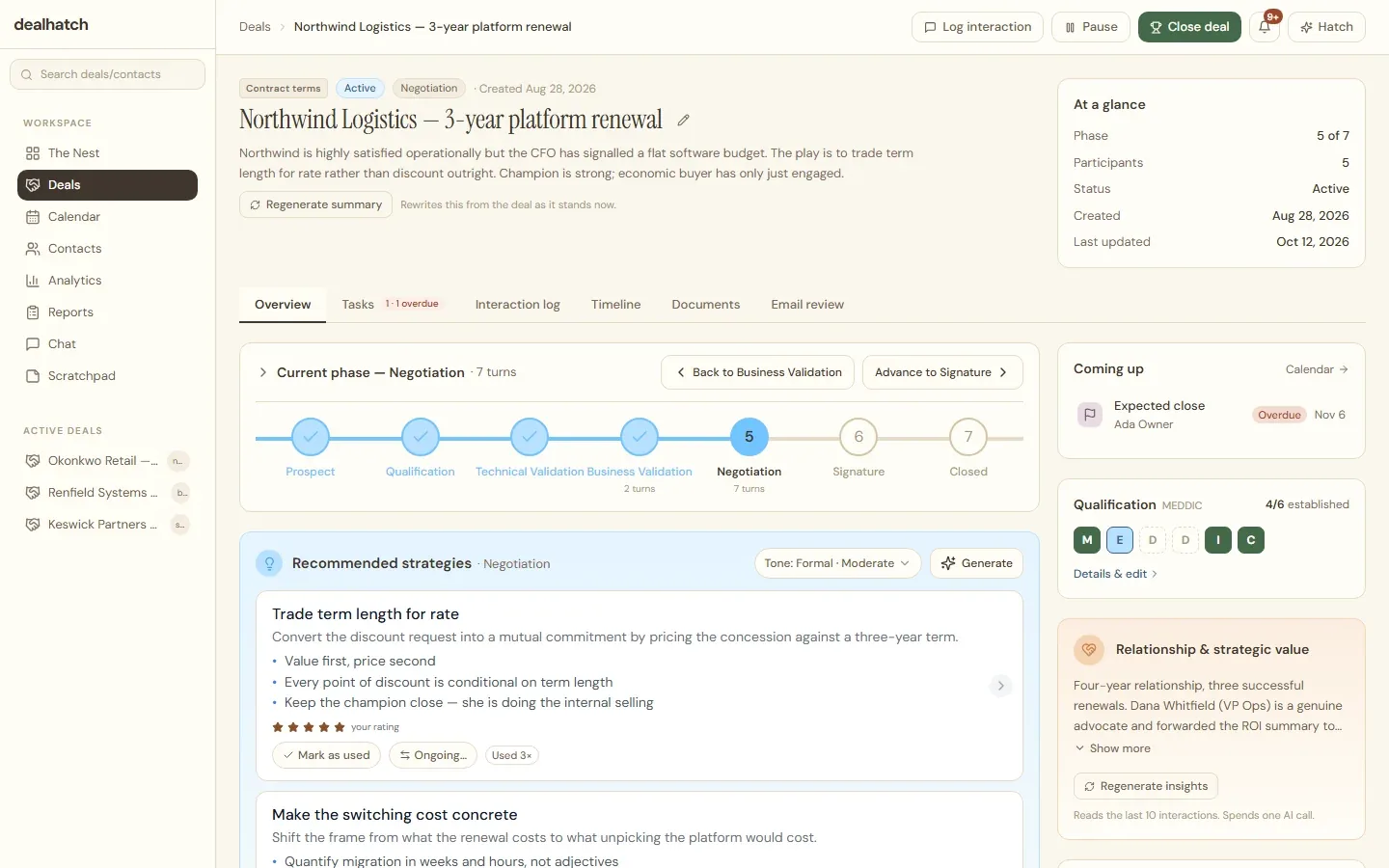
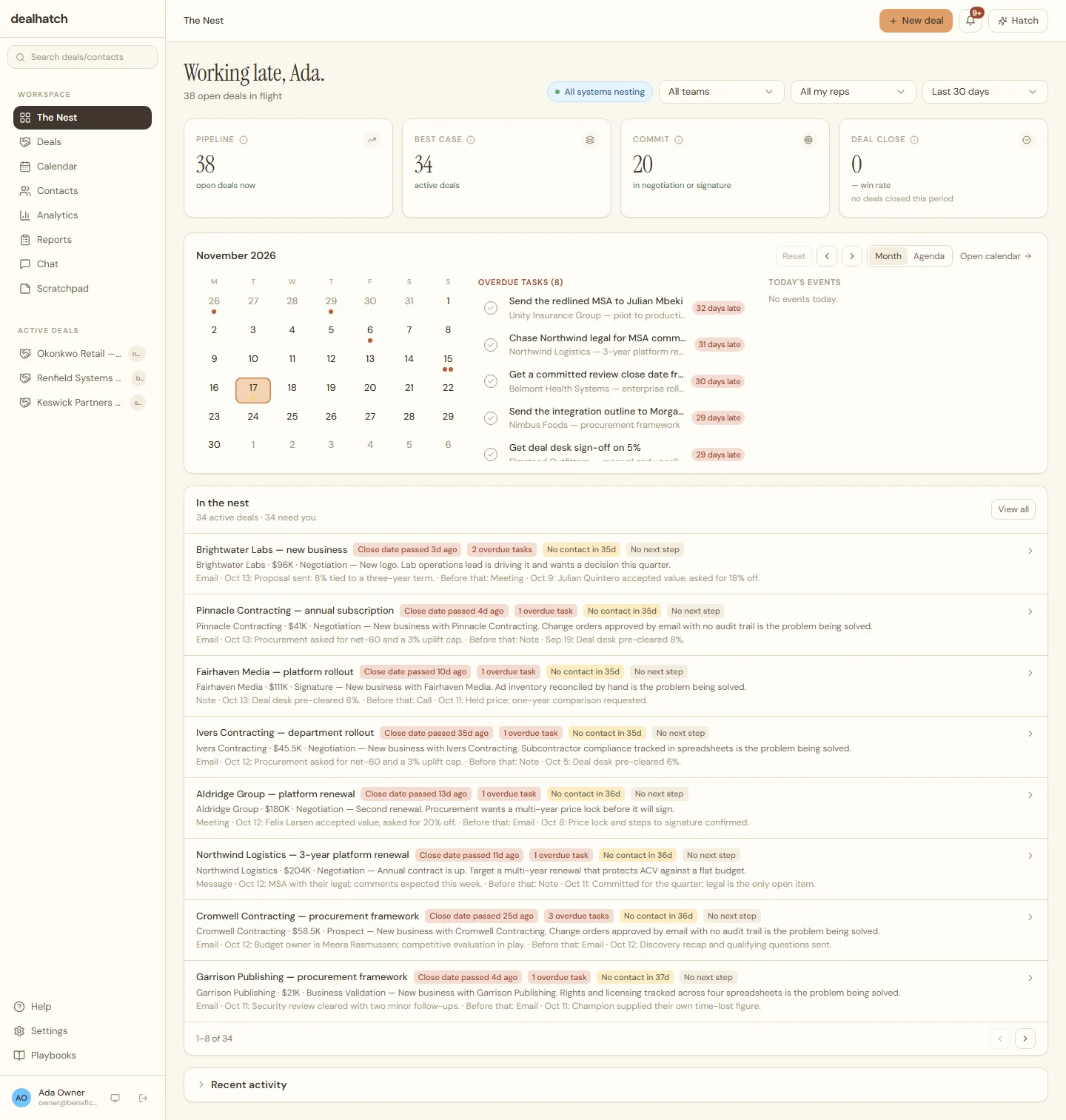
| Catching up on a deal | Reread the threads | The deal workspace shows the phase, participants, relationship summary and latest brief |
| Filing emails and meetings | Manual CRM logging, often skipped | Suggested matches queue for one-click approval |
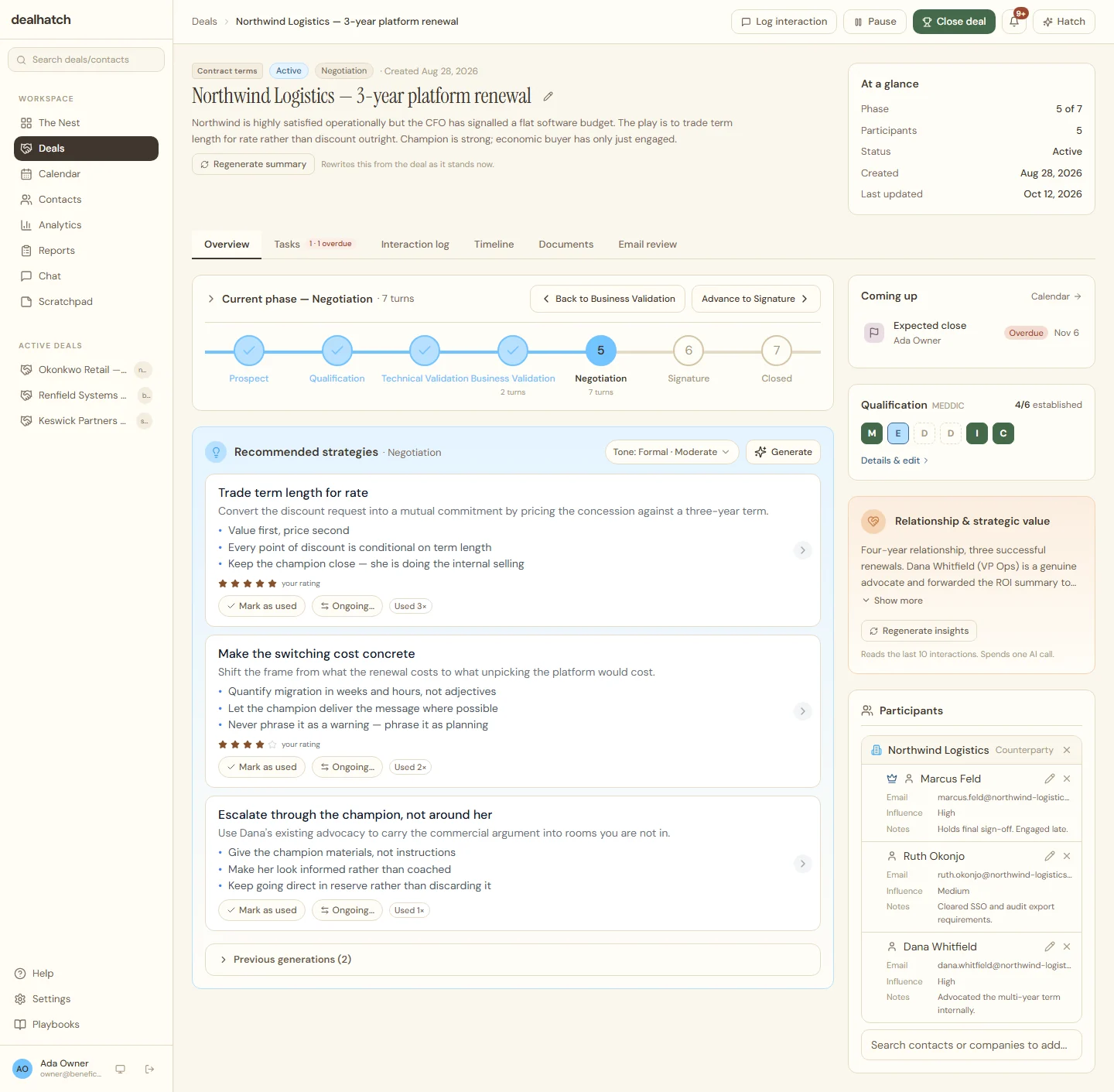
| Planning the call | Memory and generic frameworks | Ranked strategies for the deal's current phase, with pros, risks and applied tactics |
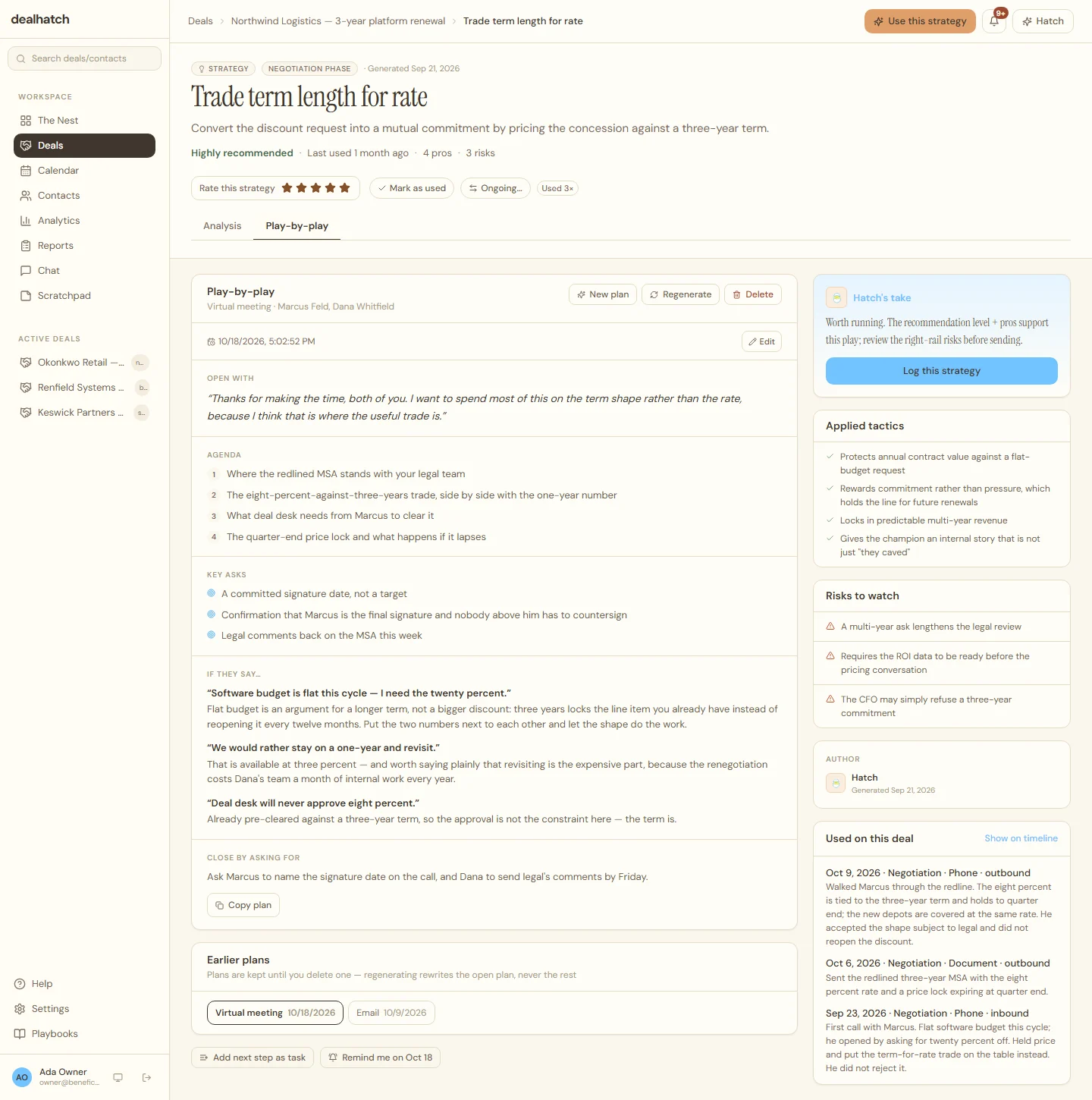
| In the meeting | Improvised | A play-by-play: how to open, the agenda, the key asks, and what to say if they push back on price |
| Trusting the AI | Check every sentence yourself | Unsupported claims are repaired or removed before you see them |
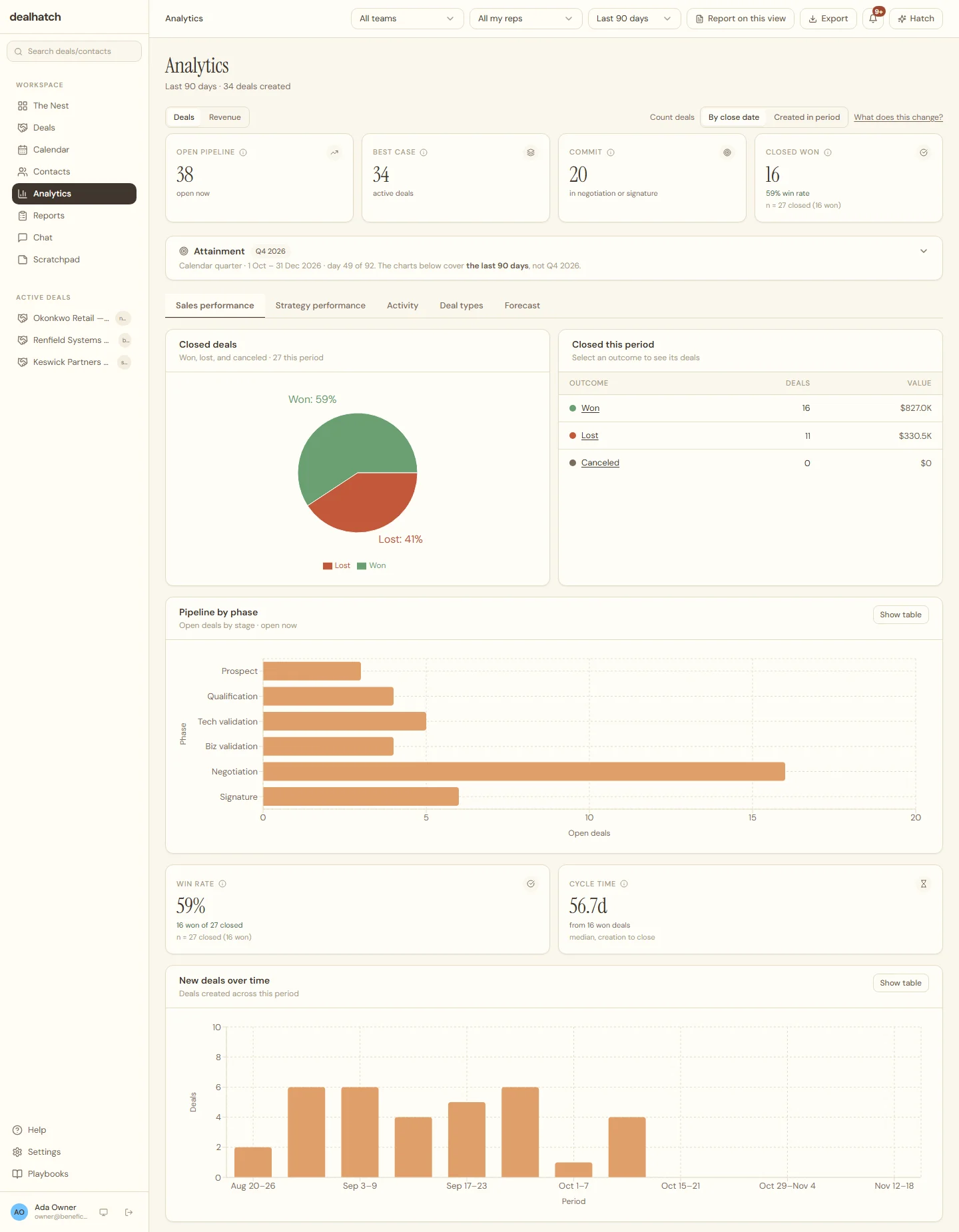
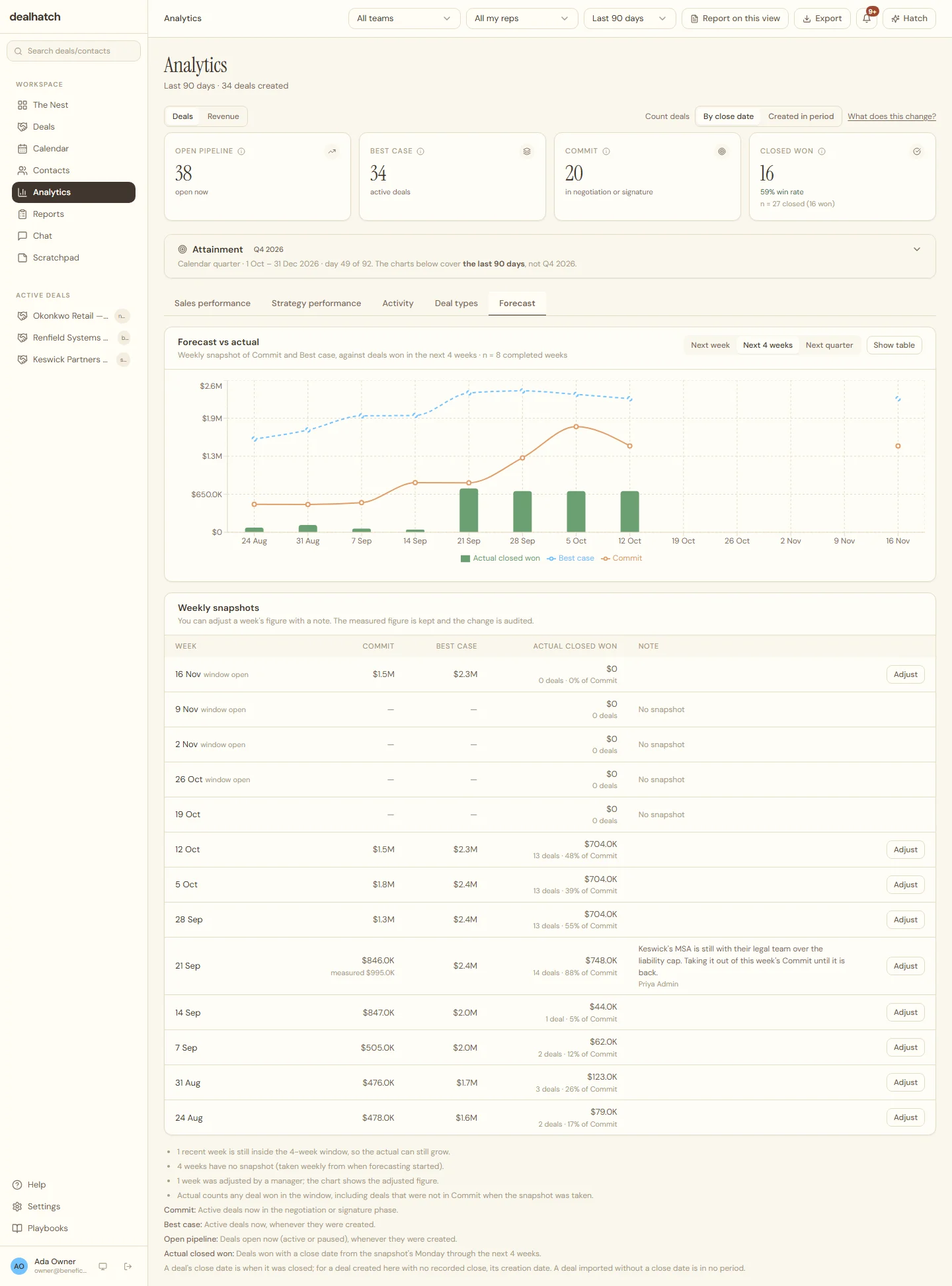
| Forecasting | Gut feeling in a CRM field | Forecasts and analytics built from the actual deal history |
Inside the build
All screenshots use DealHatch's demo workspace: fictional companies, contacts and deal history.
Under the hood
- Grounding is enforced, not just measured. The fact-check runs on every generated artifact, and its outcomes are stored and counted, so we can see how often the model tried to invent something.
- An evaluation gate for every model or prompt change. Recorded deal scenarios, including prompt-injection attempts, are replayed against any new prompt or model before it ships. Changing a prompt without bumping its version fails the build.
- No surprise AI calls. A test pins the exact number of model calls per pipeline run, so cost can't creep up quietly, and every call is metered per model.
- Tenant isolation is tested against the real database. Integration tests run against real PostgreSQL security policies in CI, and the build fails if any of those tests is skipped.
- Every command announces its target. Developer tooling prints which database it's about to touch, local or hosted, before connecting.
By the numbers
As of November 2026 the codebase has roughly 900 commits, around 230,000 lines of application code and more than 8,000 automated test declarations. It integrates with Gmail, Outlook, Google Calendar, Calendly, Slack, HubSpot, Salesforce and Stripe, and supports enterprise sign-on (SAML and SCIM).
Example scenario
Example scenario (illustrative): An account executive has a renewal meeting tomorrow with a customer under budget pressure. DealHatch has already matched three weeks of emails and the last discovery call to the deal. It recommends a value-based renewal: hold the price, offer a modest discount in exchange for a multi-year term, and lead with the ROI summary the customer has already seen. The play-by-play includes a prepared response for "your discount isn't deep enough". One draft email has a
[contract value]placeholder, because that figure never appeared in the sources.
What this means for your business
The hard part of putting AI in front of customers isn't generating text. It's making sure the text is true. The patterns in DealHatch apply to:
- Sales and account management teams that want AI preparation without AI hallucinations.
- Professional services firms (legal, consulting, finance) whose AI drafts must be traceable to source documents.
- B2B software companies adding LLM features that need evaluation gates, cost controls and tenant isolation before enterprise customers will sign.
Second Voyage builds AI systems that are held to a standard you can check. Talk to us about yours.